A soap opera of epic proportions

I had never read The Aeneid by Virgil. The title alone was enough to scare me off. But my literary and geographical horizons are expanding as I prepare for my study abroad class in September.
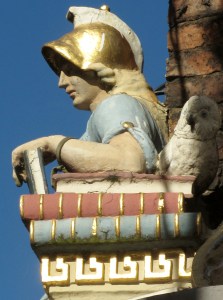
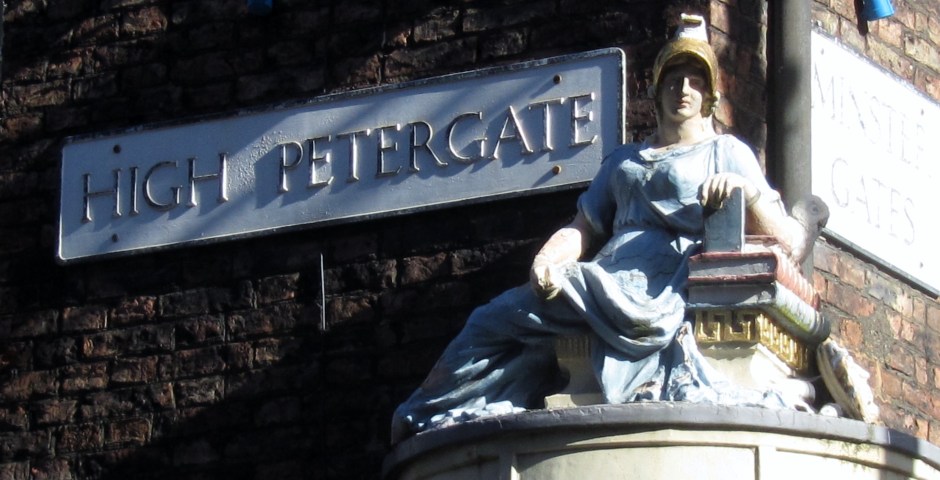
England 2012 Minerva side shot York
Minerva, Roman goddess of wisdom and the arts, perched above a street in York, England. 

Words in quotes are from The Aeneid (pronounce Ee-nid).

Book IV of The Aeneid finds the hero of the story, Aeneas (late of Troy) hanging out with Dido, the (soon to be tragic) heroine and queen of Carthage. Aeneas has lost a war but found refuge after sailing into Dido’s harbor and charming her royal socks off. Dido is all aflutter over her “princely soldier” and, at her sister’s urging, plans to marry Aeneas. She has big plans for him – to help her finish building her city and then defend it. She appeals to her gods to make it so. Meanwhile, one of her spurned suitors appeals to his gods for justice. Then the gods try to out-maneuver one another. (Cue the foreboding background music.)

Back in the earthly realm, Aeneas is a happy camper. The queen lavishes him with attention and gifts. He marries her (well sort of) in a cave after a storm and settles in to be her boy toy and build the city walls. But wait, down flies Mercury, that gilded messenger god, to chide Aeneas for becoming a “tame husband” and ignoring his destiny to build a new Troy in “the Italian realm.”

Aeneas does what any warrior would do. He pulls aside his leaders and tells them to “Get the fleet ready for sea, but quietly…” while he looks “for the right occasion, the easiest time to speak, the way to do it.” Denial on steroids: Aeneas believes he can sneakily pack up an entire fleet of ships without anyone noticing.

Is Aeneas really going to dump the queen? Stay tuned for part 2!

I’ll tell you a secret … about cement

I wonder what Roman engineers would say if they could see their buildings, roads, aqueducts, wharves and breakwaters still standing today. Maybe something like, “Dang, I knew that concrete was good!” But in Latin, of course.

England 2012 York Wall-Micklegate
Micklegate – part of the York Wall in York, England (2012)

About 2,000 years ago, Romans invented concrete using powdered lime, water, aggregate stone and volcanic ash. Across Europe, their structures remain as a testament to its hardness and durability. In this modern age, we often assume that the ancients have nothing to teach us. Not true of Roman concrete. Turns out it is better than Portland cement, the standard for the past two centuries. In 2013, an international team of researchers discovered the secret sauce to Roman mortar. A certain mixture, a certain kind of chemical reaction and a certain kind of tamping into wooden forms, produces a set harder than stone.

Not only that, the process may be more sustainable than modern-day methods. Who knew that making tons of Portland cement produces 7 percent of annual carbon monoxide emissions in the world? Not me. Read more on History.com.

I’ll be pondering the wisdom and inventiveness of the ancients this September as I trek around Rome admiring many glorious edifices clad in the arches, curves and domes much beloved by that civilization. My study abroad group will also visit Roman baths in an English city aptly named … Bath. It’s fun to begin the adventure learning about the insides of the outsides!

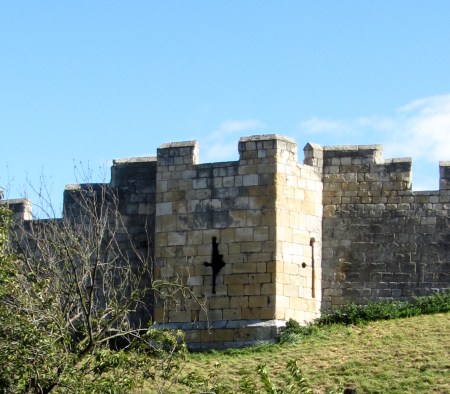
England 2012 York Wall-crop
Part of the medieval wall of York, England, built on top of a Roman wall (2012)

Wings in the wind

It’s happening again! I’m unfolding my adventure wings for an overseas trip. In September, my study abroad group flies away to the world cultural capital of London for a week and then our flock migrates to The Eternal City of Rome. Our intrepid group will trek around these global centers and take in sites of literary and artistic significance. This is a double class with a robust schedule of posts, so for those who already follow this blog, be prepared to learn a few things along with me!

England 2012 Rider close upFun factoids about London:

  • Founded by the Romans 2,000 years ago as Londonium
  • The world’s most-visited city as measured by international arrivals
  • Estimated population of 8.6 million; metro area totals 13.8 million
  • More than 300 languages are spoken within greater London
  • The London Underground (subway) is the oldest underground railway system in the world

Retrace the steps of an earlier visit to London and other parts of England by clicking on September 2012 in the right sidebar for a series of blog posts. They come complete with photos and humor. Hint: read from the bottom to the top.

Fun facts about Rome:

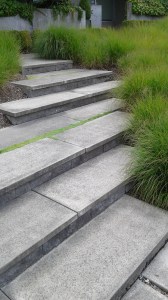
  • One of the oldest continuously occupied sites in Europe – a history spanning two and Stairs with ornamental grassesa half thousand years
  • The 14th most visited city in the world, 3rd most visited in the EU
  • Estimated population of 2.9 million; metro area totals 4.3 million
  • Hosts Vatican City, the only existing example of a country within a city
  • Birthplace of Baroque style and Neoclassicism (I know just enough about this to be dangerous)


A nest sent from heaven

wreath with pretend nestWhenever we visit my sister-in-heart, I look forward to seeing which cheery seasonal wreaths are decorating her entrance, one on each of the double doors. They remind me of her and how she swings open the portal to her home with a big smile.

Her smile had been put to the test, though. In 2015 she’d lost her husband of nearly four decades to cancer while she was recovering from major health issues. At his memorial service, Linda was pale and tired and I thought then about more hard things ahead for her. There would be many, but probably the toughest would be walking into their home. Widowed a few years before I met her brother, I discovered that a person’s presence fills far more space than the physical form.

Together with her kids, other family, and her friends she traveled the valley of grief. Faith was a shelter for her soul. A year after Greg’s death, she decided to sell their home – the place they had built together, where their three kids grew from teenagers to adults, where Greg nurtured the park-like grounds – the place she called Foggy Ridge. Another kind of grieving began.

On a day we arrived to help with preparations for the move, the doors were dressed with pinwheels of floral color, each sporting a cute pretend bird’s nest. While we were sorting things to keep or toss, Linda said, “Hey, did you see the extra nest in my wreath?” She went to the front door she keeps locked shut and to our amazement she showed us a real nest directly above the decorative one, blending into the design. I touched it gently and it was still wet – a circle of mud, grass and twigs. It had appeared, complete, the previous morning.

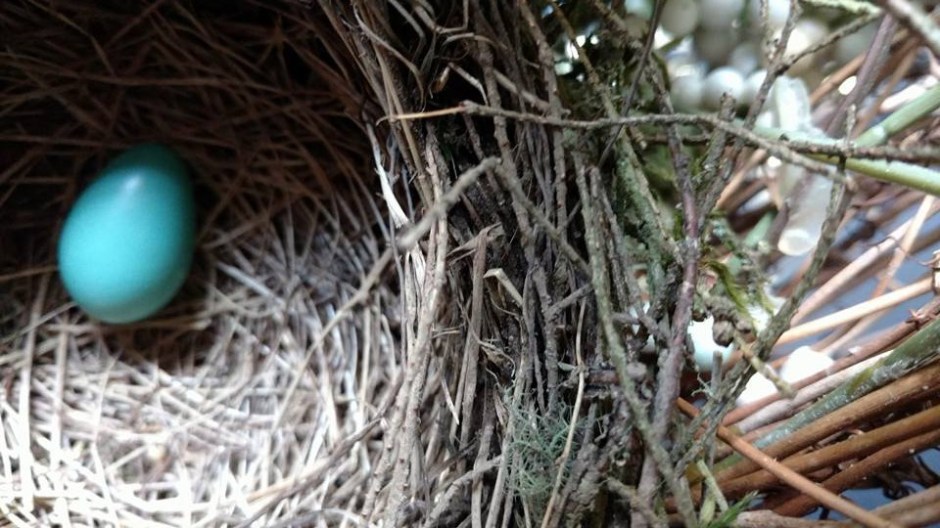
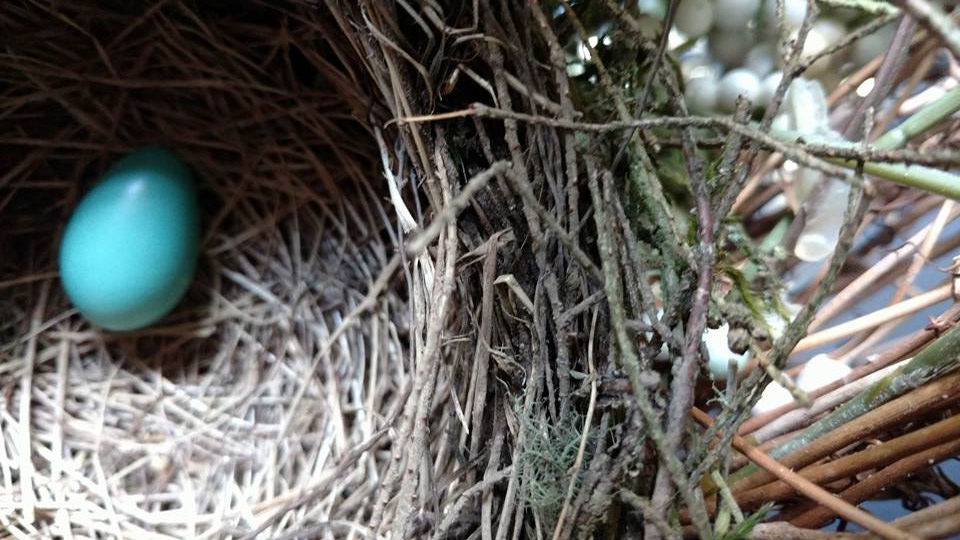
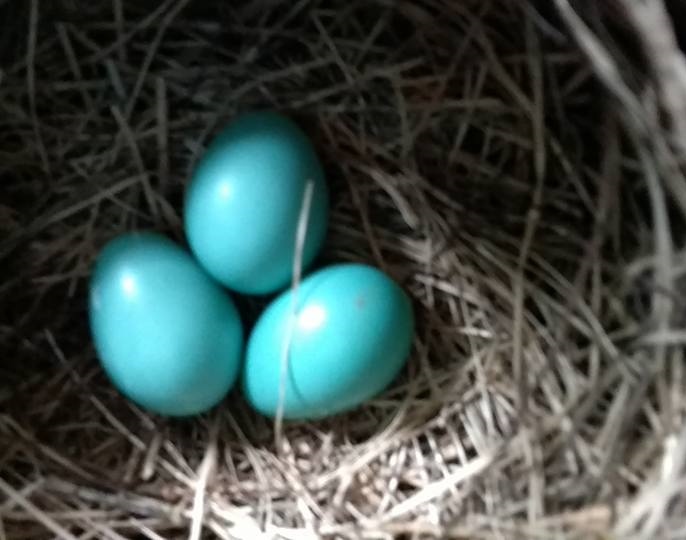
A day or two later, Linda posted a picture on Facebook. One luminous blue egg. Then another. And finally three perfect robin’s eggs perched in that avian orb. “Linda!” I posted, “You have eggs!” My heart skipped in delight. A blessing of encouragement from heaven, everyone agreed.

One egg

Three eggsTwo eggs

A few more days and another picture on Facebook: The chicks had hatched and sprouted feathers. It seems the timing of this miracle of new life was also perfect. The day she moved, she says the chicks were “all sitting in a tree with mom and dad singing a robin song.” Linda and her chicks fledged at the same time.

Feathers

Learn more about robins.


Where miracles are born

Yachats sunset

Thinking about a message from Tiffany Bluhm…

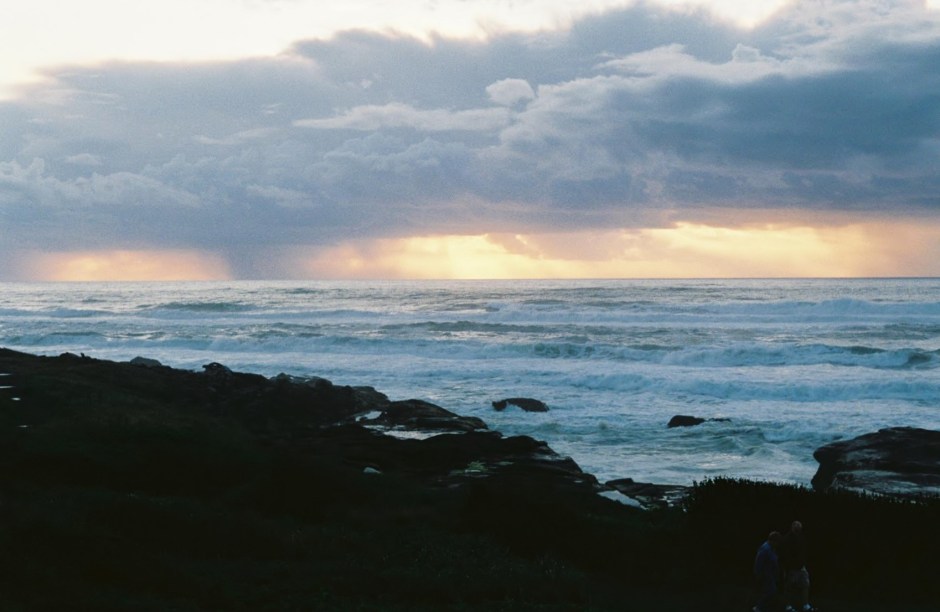
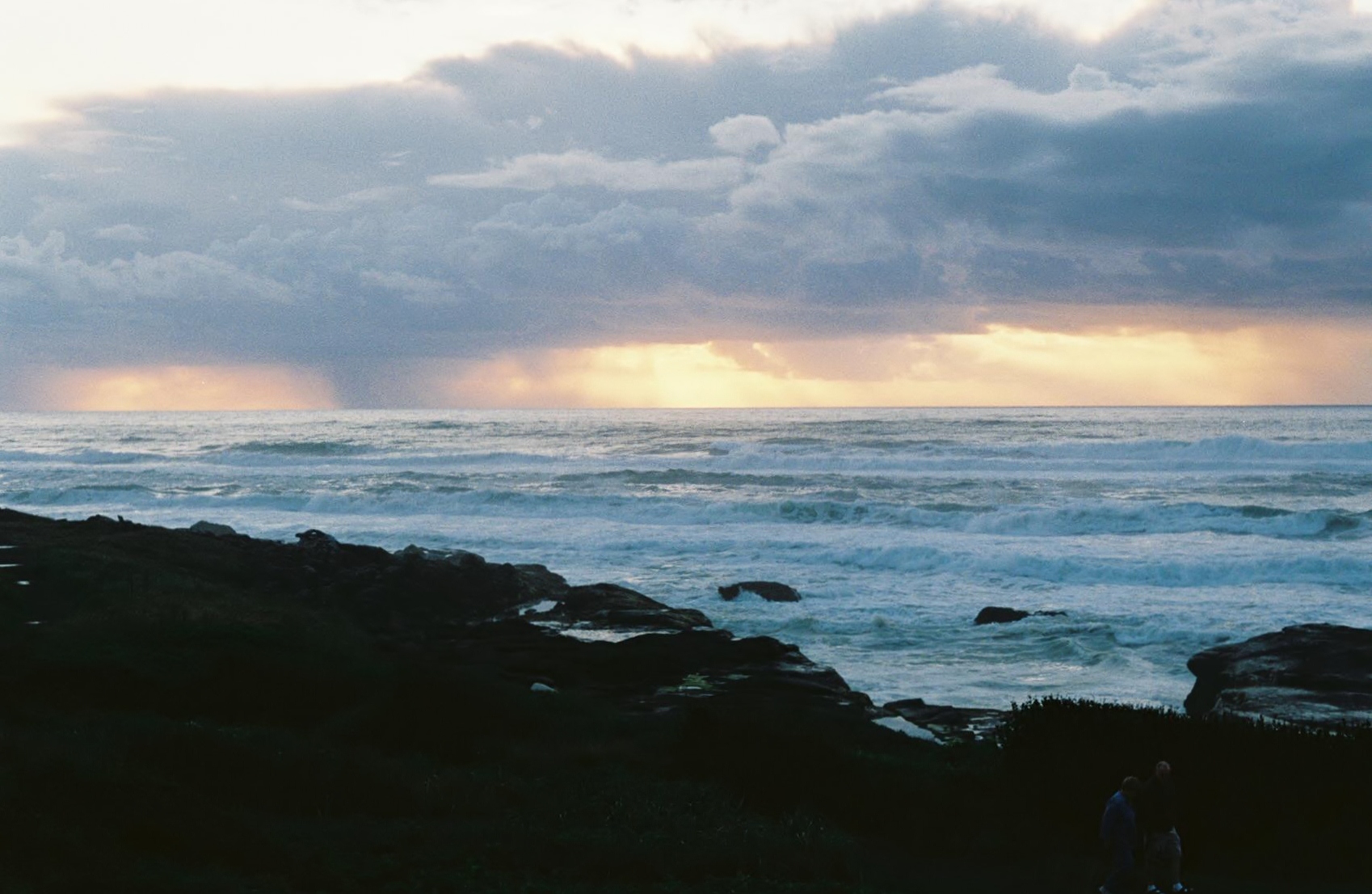
It’s the 80 percent that looks really good, she says. The part of me that works well. Ticks along like a nicely balanced pendulum in the predictable rhythm of my days. But it’s the other 20 percent of me that is like a wetlands of the soul. A place that absorbs the storms, gets all tossed around and then is drained.

I don’t like slogging through that marsh. It’s hard to walk through there because it’s muddy. There’s stuff growing but it looks kind of weird after the wind has calmed and the rain has settled back into the clouds. And yet that’s the section of my shoreline, apparently, that God is interested in. The crushed, messy part, strewn with the flotsam of days of tough sailing.

Lean into the pain, she says. That’s where the deep work is done. Where I can rise like a phoenix from the remainder, the wreckage that I keep tucked away because it doesn’t always work quite right. Little gusts of dysfunction escape once in a while and I say, hey, where did that come from? I am so OVER that. Thanks but I’d rather not lean into that, I say. Took me long enough to recover the first time around.

I know I can’t depend on an uncertain foundation. Can’t stay in a cabin I built in the marsh. I have to move inland, to solid ground. The only way through, the only path is straight across the mud. Through the barnacle-covered memories.  And weedy nightmares that cling to my ankles.

There’s somebody behind you, she says. Someone that needs what you have, what you can offer. Who needs the peace that accompanies a new journey of hope. Not the stuff YOU have planned – your tidy package is nice, it looks good, but it’s not the canvas God wants, she says. It’s that broken place, that place of shadows where miracles are born. Where the loveliness of your soul can burst forth and truly be seen. In the dark.