After a day in Needingworth at my auntie and uncle’s home, we head north to York. We take the fast train and are tucked among business people traveling further north to Edinburgh in Scotland. In little more than an hour, we hop off the train and head to our B&B.
The gothic glory of York Minster
Our first evening here we attend Evensong, a worship tradition of the Anglican church that I’ve always liked, at the majestic York Minster. This gothic cathedral has been around for centuries and dominates the landscape in the old walled city of York. At Evensong, the choir’s collective voice soars into the great realms of the ceiling, accompanied by the pipe organ’s unique sound. We reflect on Psalm 59 – here is an excerpt:
As for me, I will sing of thy power, and will praise thy mercy betimes in the morning: for thou has been my defence and refuge in the day of my trouble. Unto thee, O my strength, will I sing: for thou, O God, art my refuge, and my merciful God.
The literary beauty of reverence is present. I read in the prayer book that Evensong – evening prayer – is largely unchanged since the mid-1500s. I think about all the voices that have harmonized in this vast building during the centuries and my heart is moved by this celebration of creative song.
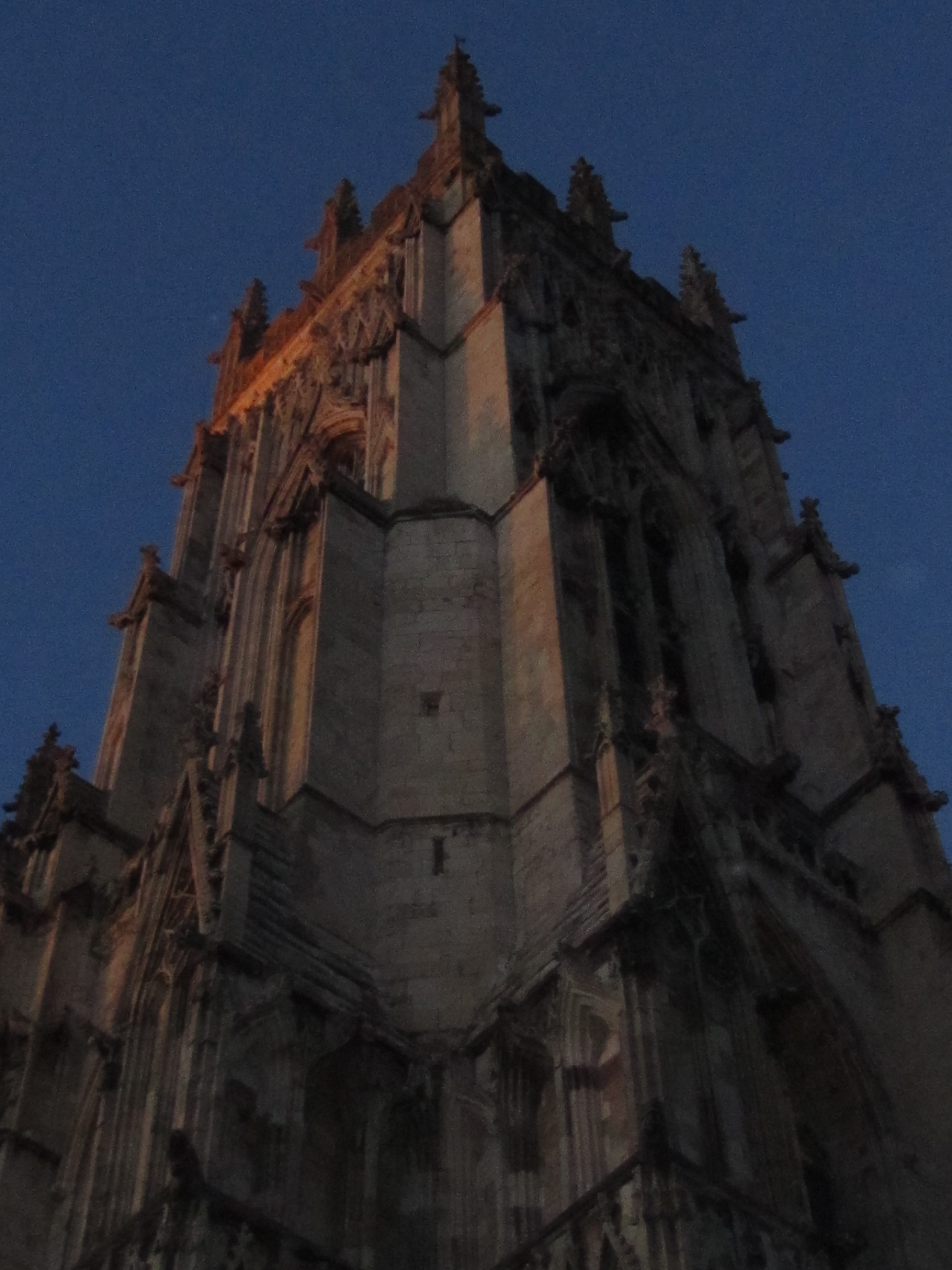
The minster at dusk
We have a video clip of the bells of the minster ringing at dusk that is fabulous – I hope to be able to post it.
The roots of the University of Cambridge reach back to the 1200s when a group of scholars left Oxford due to conflicts with townspeople there. Nowadays there are 31 colleges in Cambridge that operate independently but all degrees are conferred by the university. The website has loads of fascinating historical information: http://www.cam.ac.uk/colleges/.
So many accomplished writers have studied at Cambridge: John Milton, John Fletcher, John Harvard, Lord Byron, Alfred Tennyson, William Wordsworth, Sylvia Plath and more. I am thrilled to be walking on the grounds.
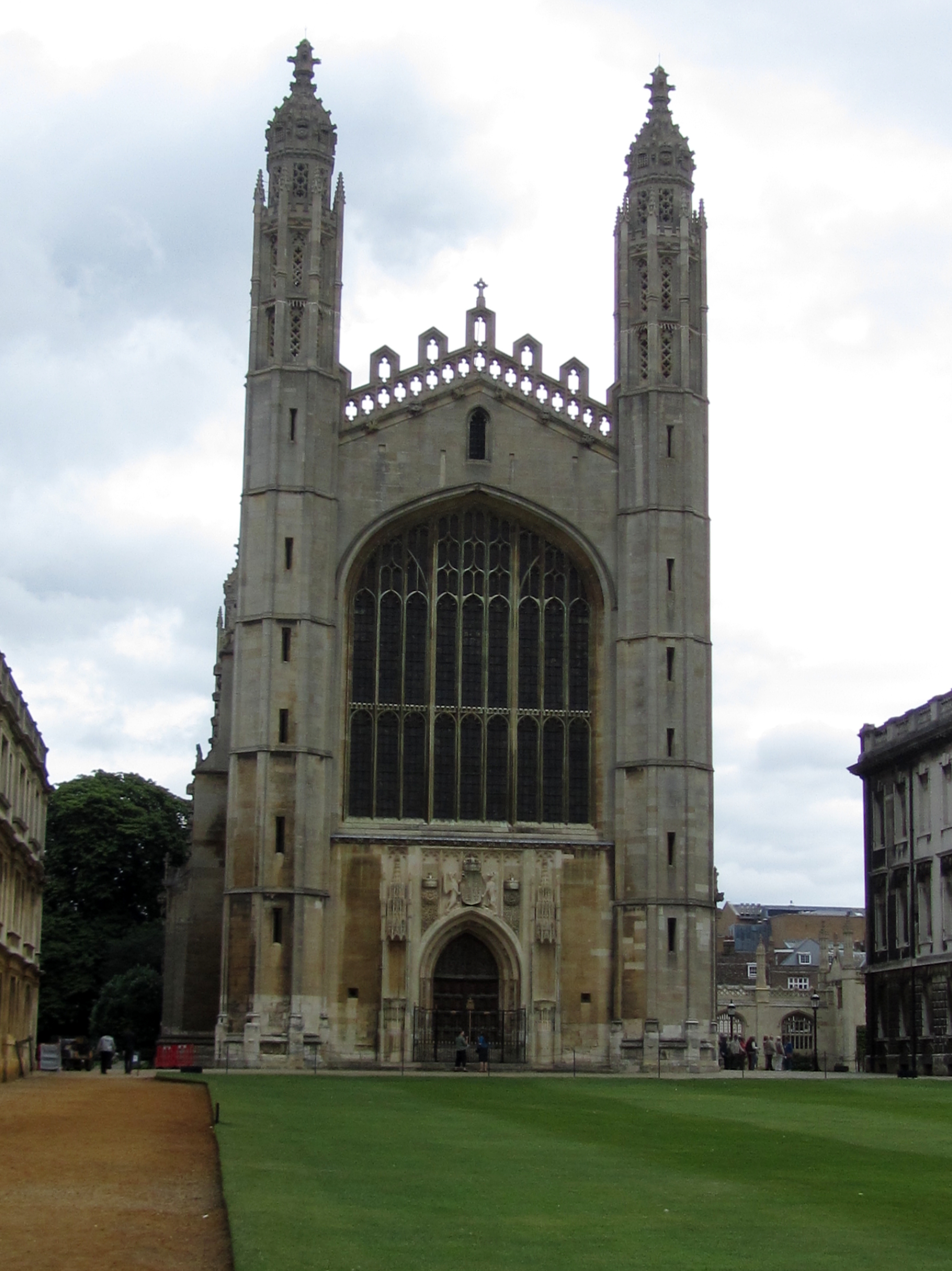
King’s College Cathedral at Cambridge (and please keep off the grass)
We visit King’s College and are duly impressed by the cathedral’s architecture and truly amazing organ, which features large angels on either side grasping imposing trumpets. Historical plaques trace the building’s history with kings who helped pay for construction and the colorful stained glass windows. In medieval times the royals kept themselves busy imprisoning each other and deposing and frequently killing off heirs to the throne. Richard III seems particularly bloodthirsty, but was he really? When the Tudors (the last two Henrys through to Elizabeth I) took the throne they embarked on a propaganda campaign to blacken Richard’s reputation and turn public favor toward the already-dead Henry VI. This went on for about 100 years and culminated, according to the University of Cambridge, in Shakespeare’s plays Henry VI and Richard III, in which Richard is an arch-villain and Henry VI is glamorized as a hero.
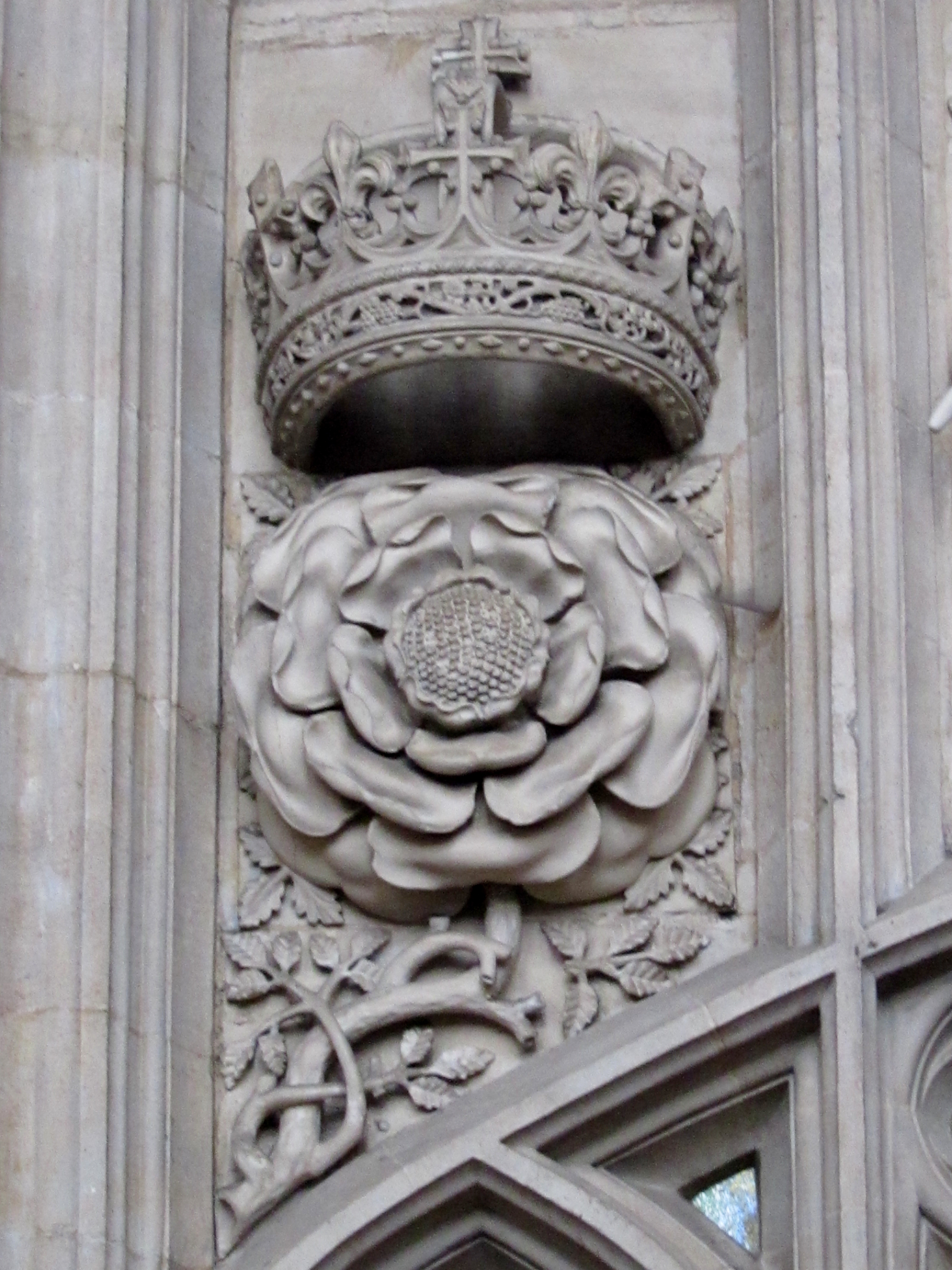
Inside the cathedral
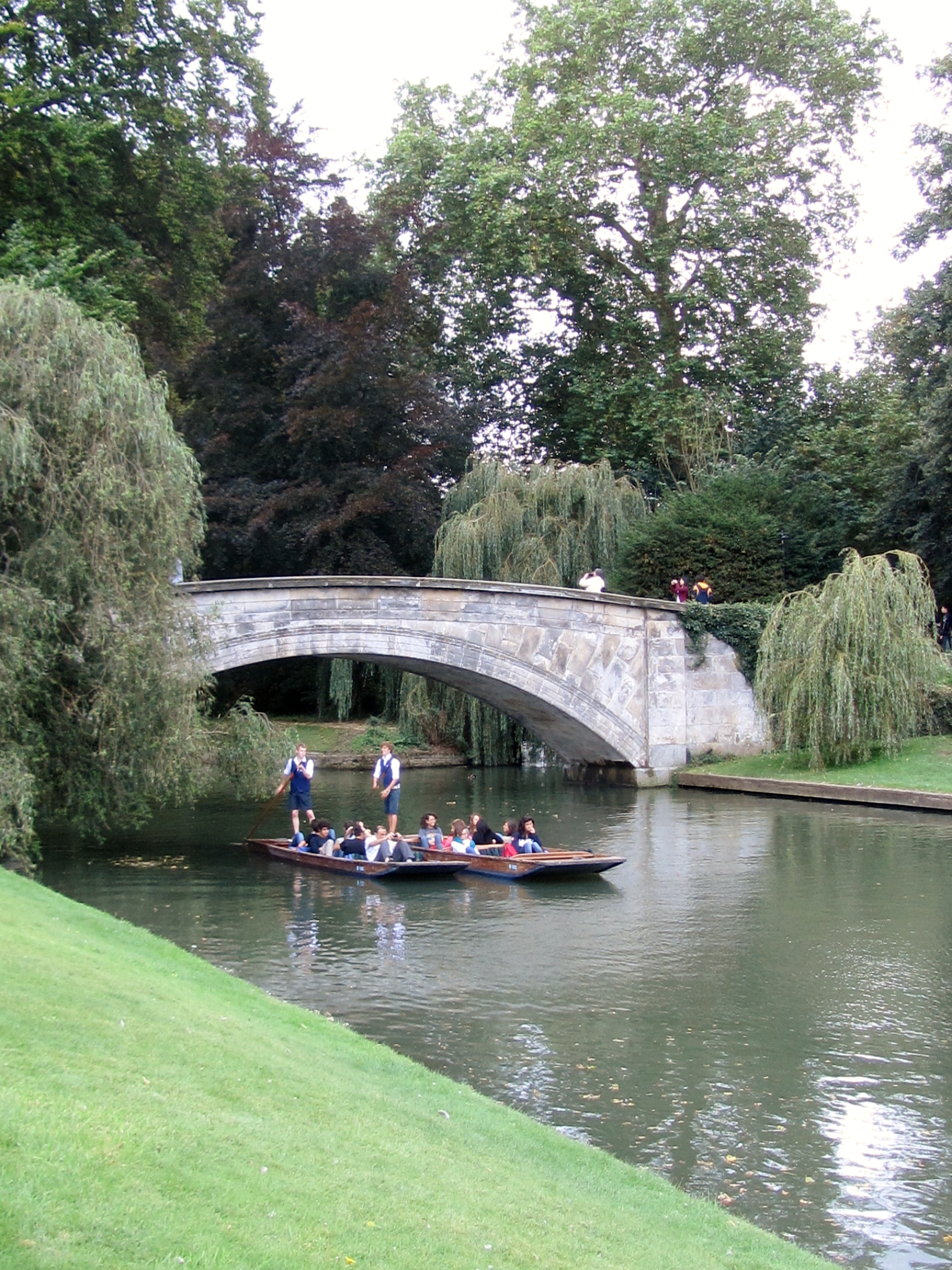
Outside the grass is lush and green. We are amused by many small signs telling visitors to keep off the grass and other signs announcing that masters may walk on the grass. Walking down to the River Cam, we see the famous punts filled with tourists moving slowly up and down the stream. The scene truly looks like a postcard. I think about the university’s website that says a bridge has been in this area since at least 875. Wow.
The River Cam
I wish I could stay longer but I want to visit another auntie who is now in a nursing home. We walk into her room and as she turns toward me, I see my father’s face and then my sister’s eyes. Even though she is physically frail and struggles with short-term memory, her spirit is strong and she perks up during our visit. She does not let go of my hand for a long time. She cared for my sister and me when we were very little and her heart goes back to that time, remembering how we looked, describing my sister as a little angel, so pretty, so sweet. I am touched by the depth of her love. We drink tea and I tell her she looks really good. She asks me to keep writing and I promise that I will, as I have through the years. I blow her a kiss as we leave.
My better half has fallen deeply and irrevocably in love with Hot Sticky Toffee Pudding, garnished with vanilla ice cream. As he consumed this British confection, he made such soulful remarks as, “Wow, why don’t we have this back home?” and “We have to get a British cookbook!”
It’s all part of his effort to experience full cultural immersion via cuisine. This has led to his discovery that, in England, not all puddings are dessert. At a York bed and breakfast he got quite edgy in his selections, sampling Black Pudding for breakfast. The ingredients are pretty simple: pig’s blood and herbs. (Aagh!) He took a couple of courageous bites as I looked on in disgust.
That adventure makes an earlier choice of kippers – salty smoked fish – and eggs for breakfast seem almost mundane. He ate the entire serving as I tried to concentrate on my porridge (oatmeal).
We notice that baked beans and/or mushy peas (just as they sound) seem to be available with pretty much anything, up to and including lasagna. Umm, lasagna and baked beans? And, everywhere in England, the ubiquitous chips (French fries) are available. They are very good and quite addictive. In the end, we don’t really have to worry about strange flavors because anything and everything is washed down with cups and cups of tea.
My better half has video footage of tea shop display windows with their array of sweet cakes and other goodies. It’s a love story in the making, or should I say baking.
The medieval city of Rye is not far from Hastings so we hop on a double decker bus and head for the top floor. An old gentleman gets on at the next stop with an accordion slung across his back and a border collie in tow. It continues to be hot and as the bus fills with travelers we are glad that all the windows are open. We are charmed when the elderly gent breaks out the accordion and gives everyone a keyboard rendition of the song Summertime followed by a few other classic tunes. I appreciate the distraction because the bus is moving quickly down a very narrow lane, and I keep flinching as we pass roadside houses by mere inches. My line of sight has me looking directly into people’s rooms. Who would want a bunch of faces in a bus flashing by their living room every hour?
In the medieval town of Rye
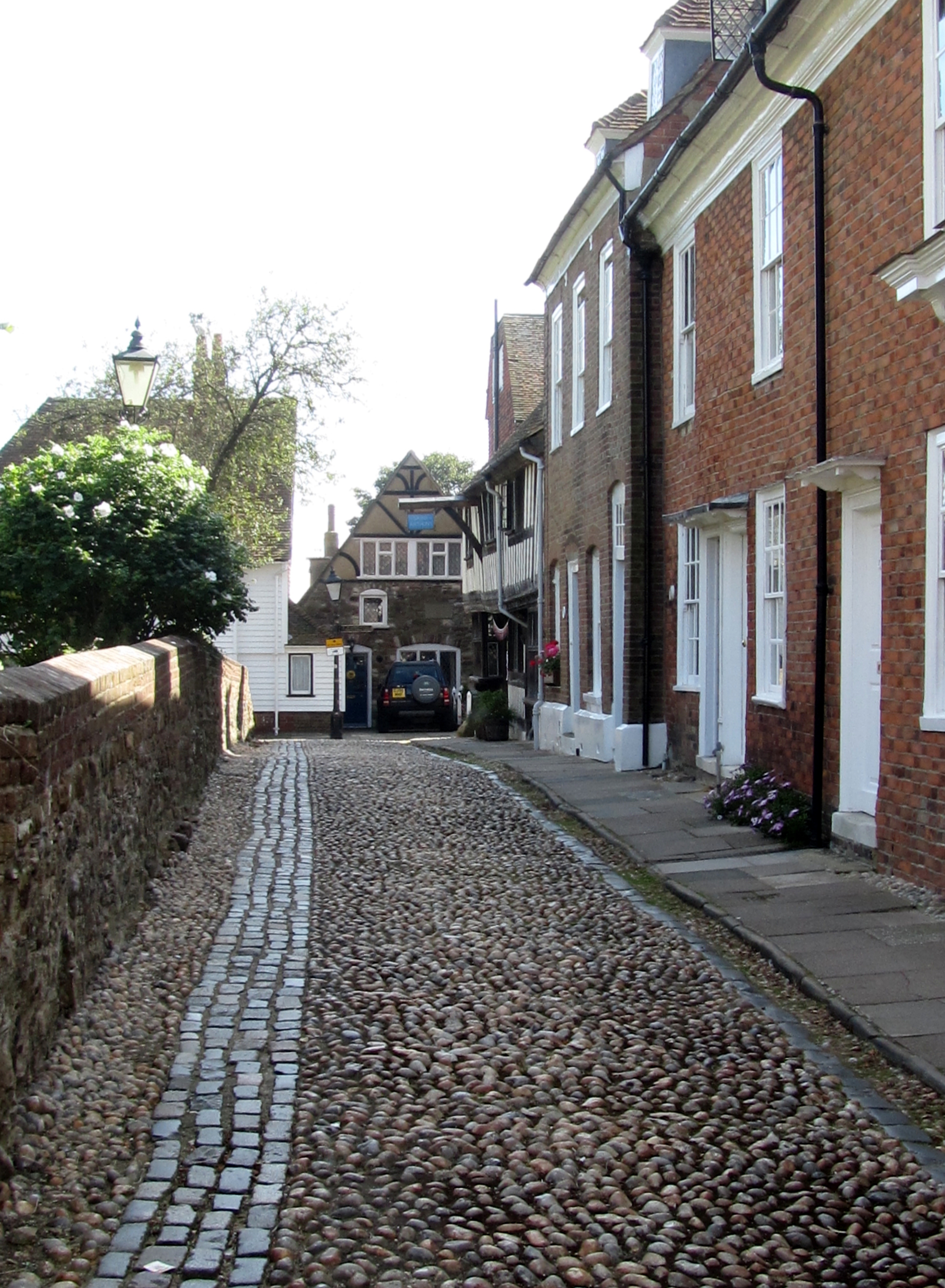
Off we get in Rye and find narrow sidewalks lined with compact old – really old – buildings. Some have signs saying they were renovated in the 1400s. (!) The streets in the medieval section of town are, of course, narrow and frequently are made of rocks set in some type of cement or concrete. Real, bumpy rocks that are difficult to walk on. Even in my sensible shoes I have to work at keeping my balance. Locals in dress shoes zip by, demonstrating their rock-walking abilities. Cars drive on these streets, with a whumpa-whumpa-whumpa sound that must make tire companies smile contentedly.
The rocky roads of Rye!
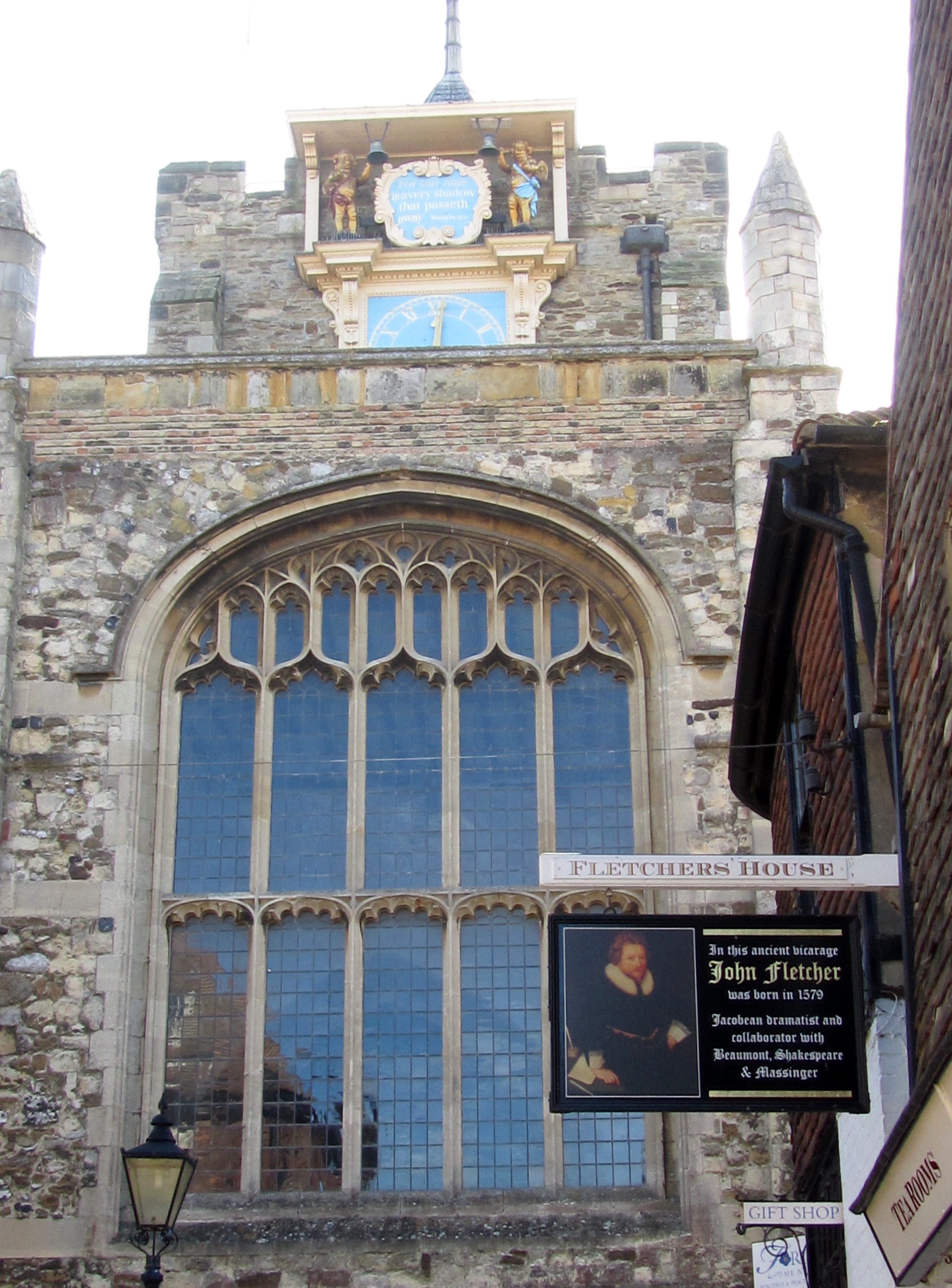
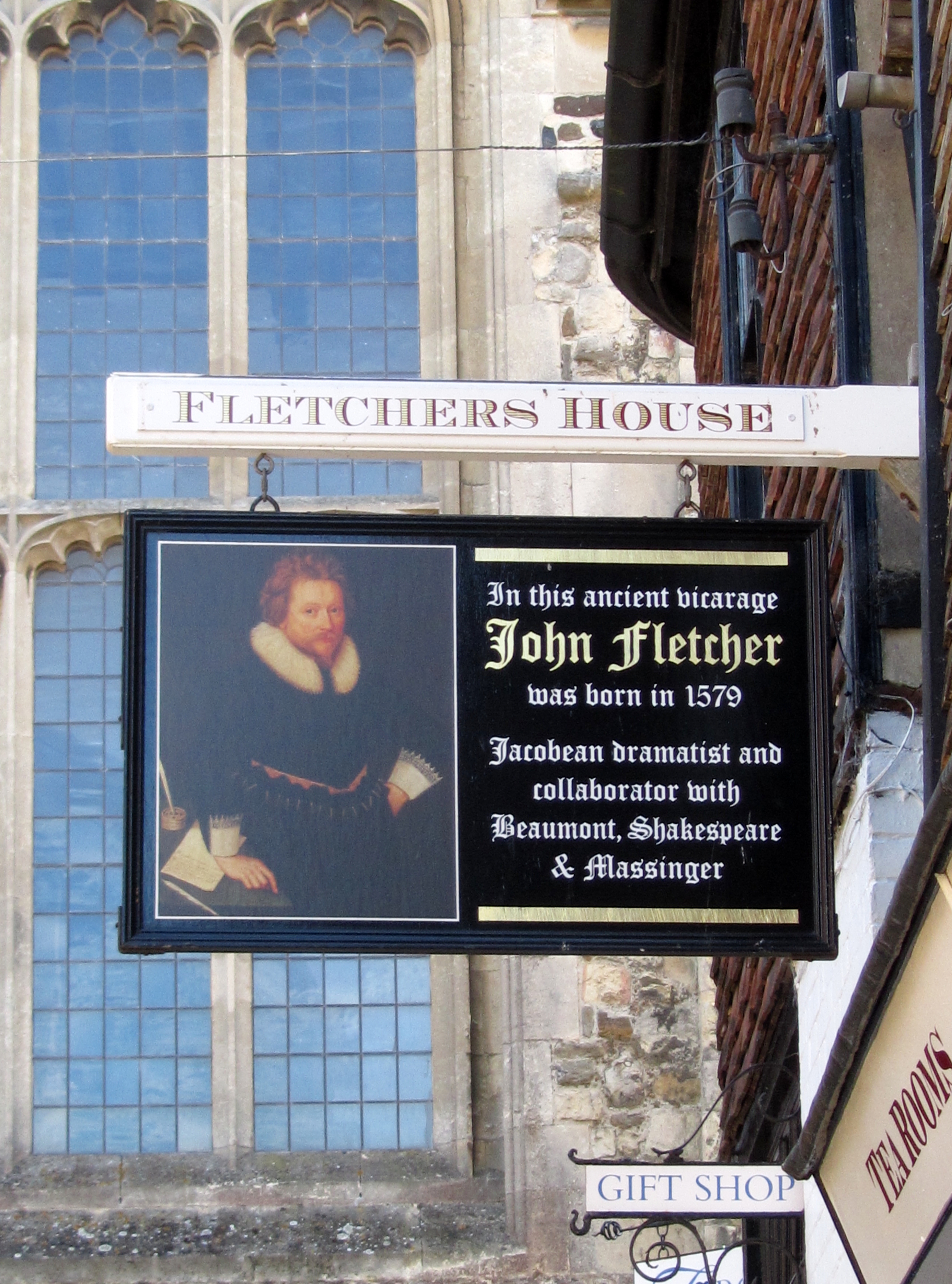
Up a hill and around a corner we see a sign marking the birthplace of John Fletcher, who entered this world in 1579. I don’t know much about this playwright, who was a contemporary of Shakespeare. According to the Francis Bacon Research Trust, he is thought to have collaborated with Shakespeare on Henry VIII and The Two Noble Kinsman. He was best known in his day for comedy, his most famous play being Knight of the Burning Pestle, which he wrote in collaboration with Francis Beaumont. Luminarian.org says that Fletcher probably was involved in writing about 42 plays, with a style that is “fast-moving, well-constructed and, in the case of the comedies, still funny.” I remember reading at the Globe Theater in London that Fletcher was more popular than Shakespeare for at least 100 years. Any writer who is still funny after 500 years is worth reading! I mentally add this playwright to my must-read list.
Birthplace of playwright John Fletcher, a contemporary of Shakespeare
Tomorrow we head to Cambridgeshire to visit with more aunts and cousins – this time on my father’s side of the family – and enjoy a trip to learned Cambridge.
I knock on the door and when it opens, I see a pair of eyes so similar to mine that I am a bit startled. My maternal cousin Hope, with whom I have corresponded for 30 years since we last saw each other, is welcoming us into her home. She lives in Hove, a town right next door to Brighton. It is compact, as all English towns seem to be, and has been her home for many years. We exchange stories, and I listen to family history that fills in some blanks and provides some surprises. She is the child of my late grandfather’s brother and tells me that most of the siblings were musical, the patriarch played several instruments and his wife worked in the theater as a “dresser” (costuming, I think) and also sold antiques on the side. This is amazing to me, as my grandfather did not demonstrate any interests along these lines. He was a rather good writer and perhaps this has passed to me.
I think about my other maternal cousin, Karen, whom I met for the first time in London earlier on our trip. She shared photos and stories of my late grandmother’s family. In Karen’s family photo albums, I see the face of a boy of about eight – the same face that is in a locket I’ve brought with me to England in hopes of learning his identity and that of a toddler girl in a companion photo. The locket was among my grandmother’s things after she passed away. I discover that they were grandma’s siblings, their names were Billy and Pat and they died shortly after the photos were taken. Billy is fair haired with a sweet smile and reminds me of Karen. Pat has a head of dark curls and for years I thought she was my grandmother. I think that Grandma must have felt those losses deeply to have kept the locket all of her long life. Another sister, Hilda, died as a young adult. Other photos show dark-haired men and women in their prime, my great aunts and uncles before their metamorphosis into elderly people filled with memories and stories. I can see that in their youth they were somewhat bohemian, unafraid to be unusual and unconcerned about social norms of the day. Karen tells me about her creative life – she paints, sings and writes. Streams of creativity and independence flowing through my DNA.
The vines of life and death are weaving through our travels and we feel the tug of our personal histories around our hearts. We are nurturing our family trees, giving them deeper roots and, hopefully, richer dimensions for the future.
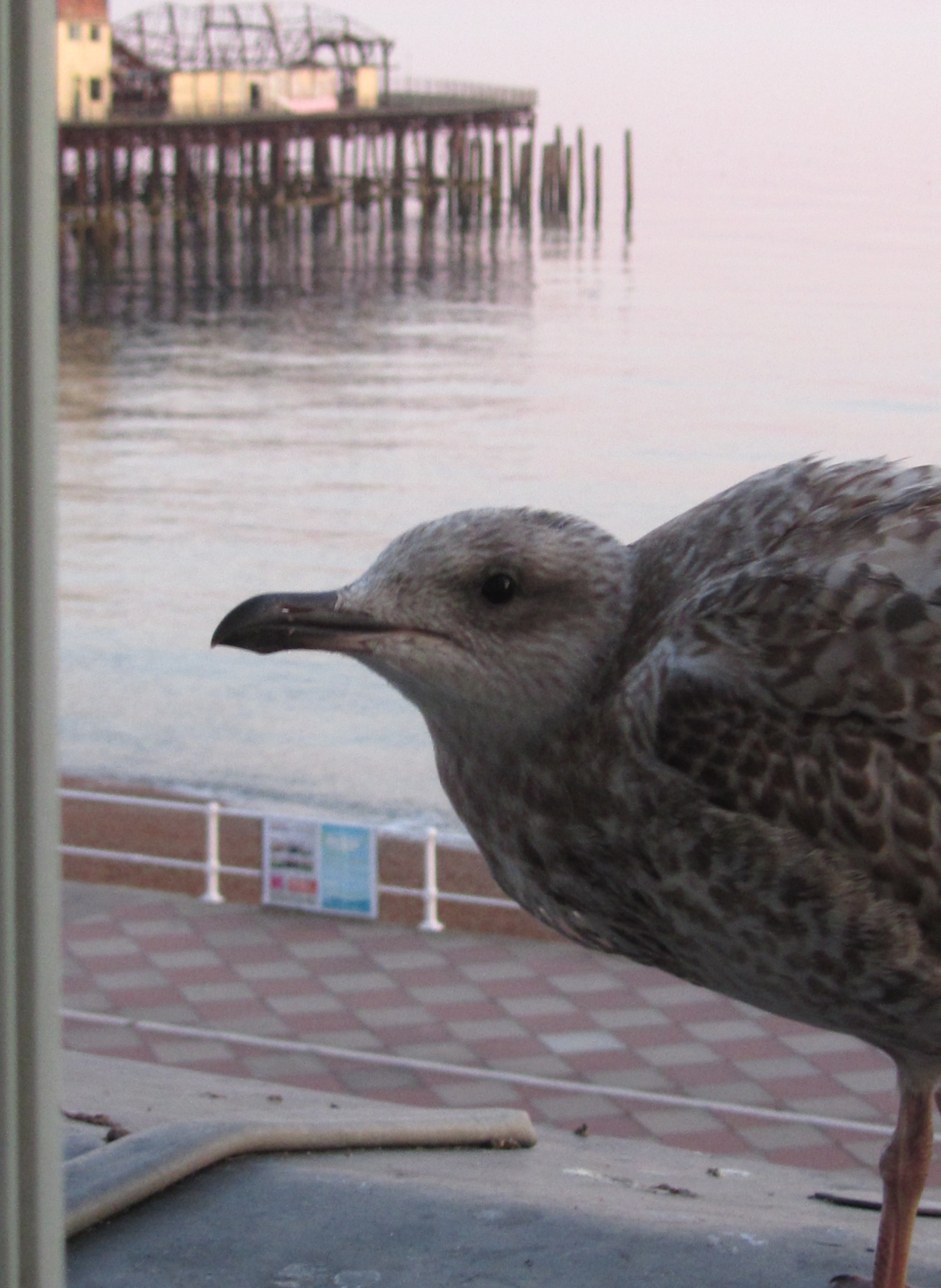
We look out the window at the English Channel – clear proof that we’ve arrived at the south coast town of Hastings. People don’t walk quite as fast here and are not so often dressed in suits. We’ve come to search for my better half’s ancestor and for me to reunite with another cousin after 30 years of corresponding across a continent and the Atlantic. Our bed and breakfast window allows us a bird’s eye view of the seashore and promenade, where we see locals strolling, walking their dogs and riding their bikes in the warm sun.
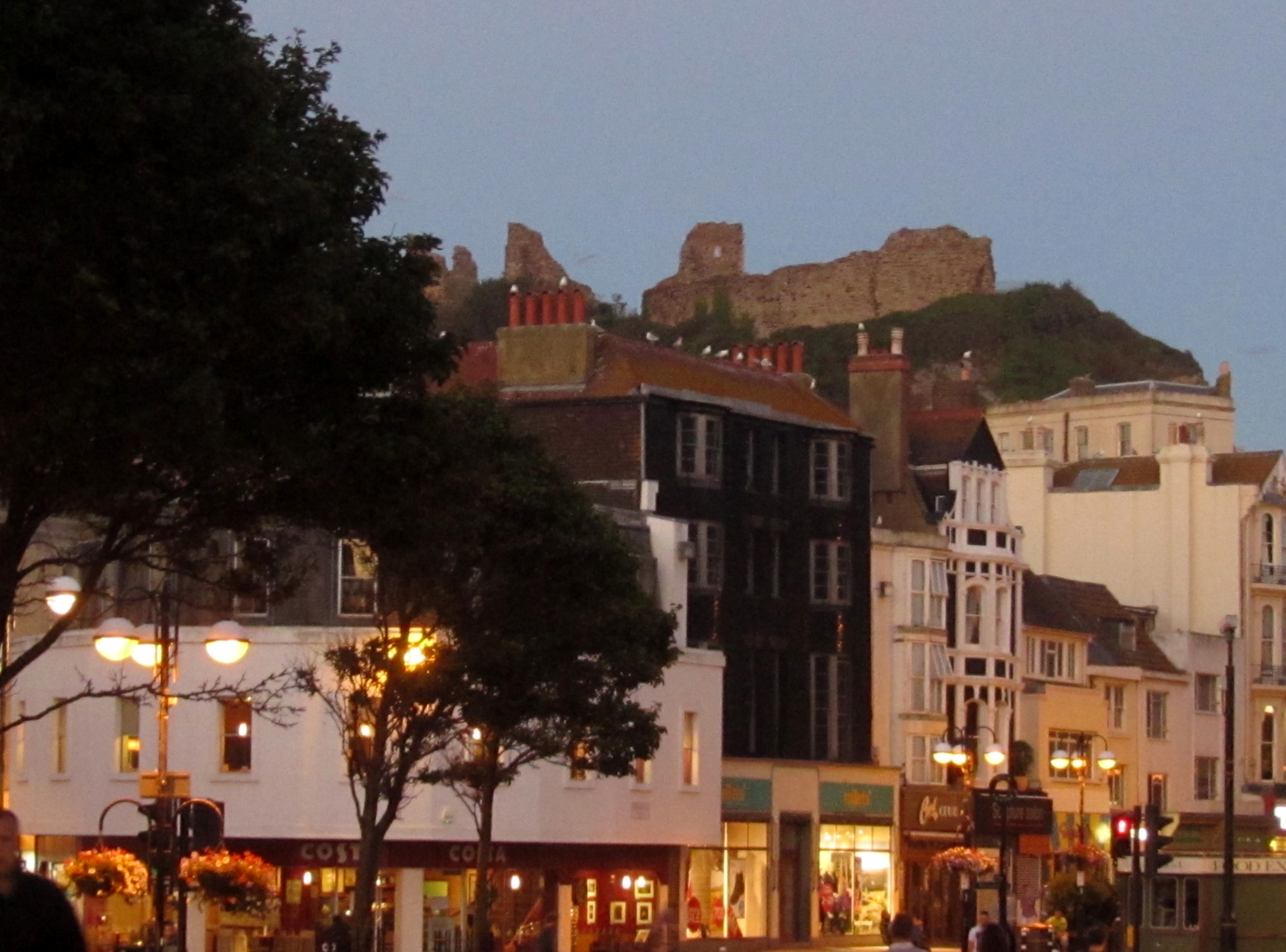
Ruins are everywhere in this country and, as we walk on the promenade, we look up to see what is left of a castle tower on a hill in the distance. It, of course, is ancient and overlooks the 20-some miles of sea between England and France, where so many battles and invasions have taken place during centuries past. I am surprised to learn that the battle of 1066, often referred to as the Battle of Hastings – or locally simply as The Conquest – actually took place some miles inland at a place called, not surprisingly, Battle. It is in this area that my husband’s great-great-great grandfather, William Davis, lived, worked and died.
Castle ruins above Hastings
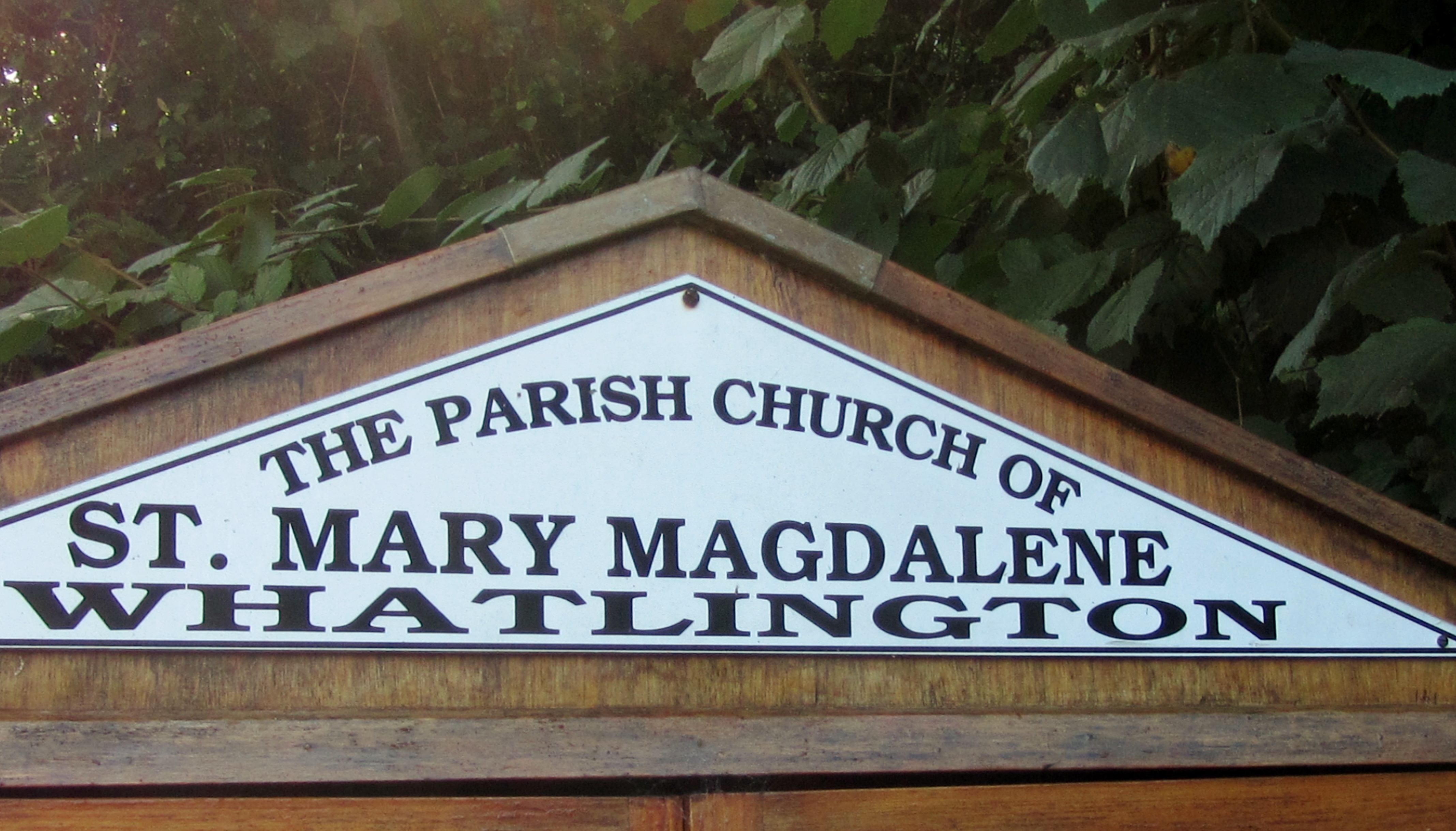
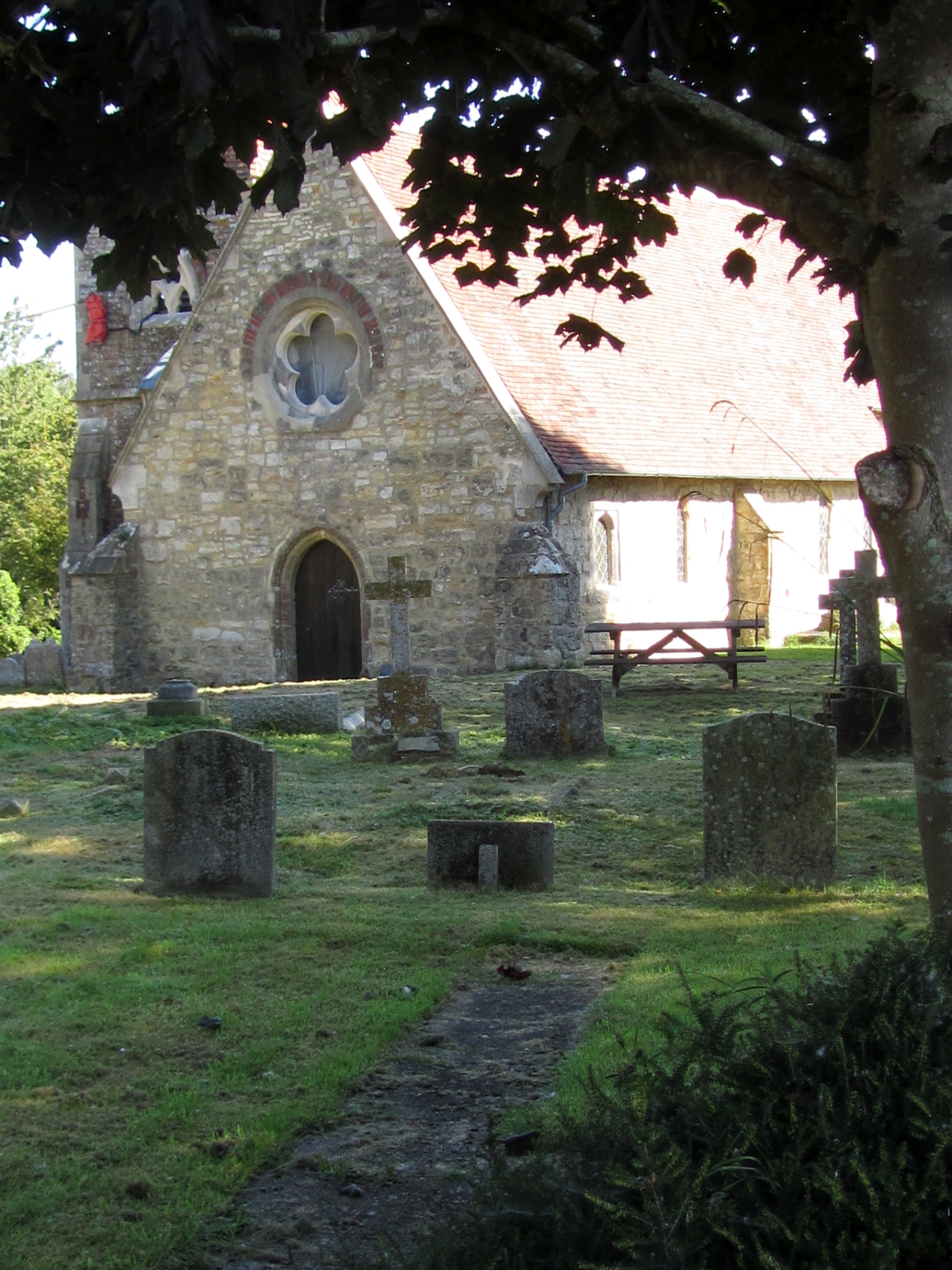
My better half has done yeoman’s work researching William’s whereabouts and after a search of the first census in the area, learns that William was buried in the parish church of a little hamlet called Whatlington, near Battle. We take a cab and are glad we did because the driver, a local, can barely find the church even with his knowledge and a GPS system. Finally, down a road barely wide enough for one vehicle, we see a small wooden sign for the church at the foot of a lane leading up a small hill. The cab driver asks us more than once if we are in the right place and we assure him that we are. We hop out and read a posting that explains the church is closed due to a fire in 2010. We also learn that a church has stood in this location since before The Conquest. Walking up the small lane, we meet a neighbor, a gardener and a church warden (deacon). Not bad for a closed church! My husband explains his quest to the warden, who is kind enough to take us inside the current church building, which was constructed in the Middle Ages and renovated during Victorian times. (!) It is so moving to see a lovely old building being carefully restored with period materials, right down to the lime plaster on the ceiling, which is mixed with horsehair. (!)
Outside, the church is surrounded by graves. Many have not weathered the years in legible condition. One section houses stones that date from the mid-1800s. William died in 1843 at the age of 66 and we think he is buried in this section, but cannot see his name or initials on any of the legible stones. It still is very meaningful to walk through the churchyard, thinking about this ancestor, whose son emigrated to America and began a branch of the family that continues and thrives today. We look out over pastures and feel a cool breeze waft by. No one is in a hurry here. On the way out, my better half meets a neighbor who knows a member of the parish who has a map and history of the graveyard. This is a terrific lead and we’ll follow up to see if we can confirm William’s resting place, here in a quiet corner of England, surrounded by layers of history.
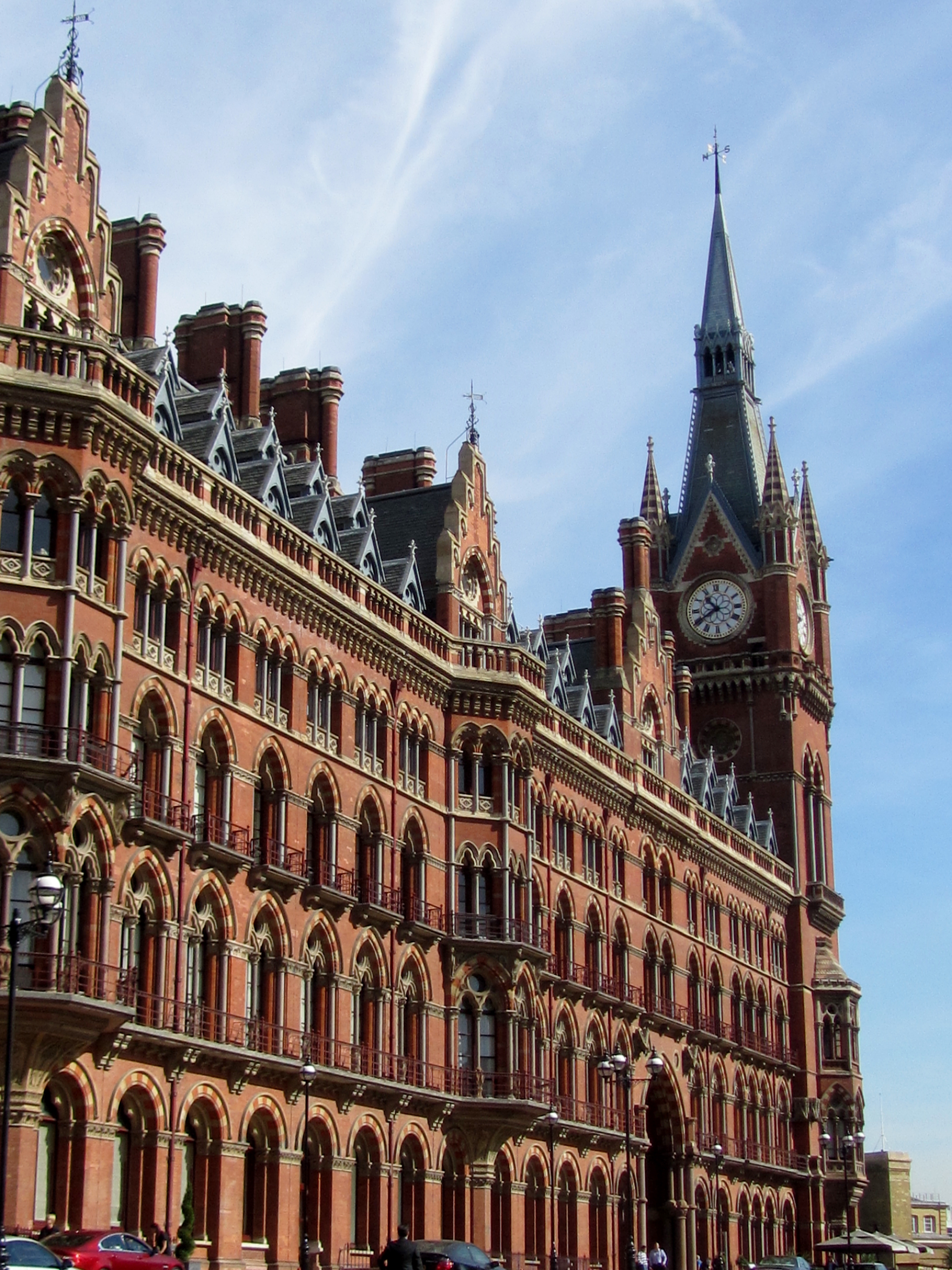
Our senses are saturated, our minds filled with information. We’ve only scratched the surface in London but our visit has come to a close. There will be more blogs about our experiences in this ancient yet so modern city. The British Library deserves its own post – we saw a special exhibition entitled Writing Britain (www.bl.uk/writingbritain) and then encountered the incredibly amazing Treasures of the British Library. To use an English term, we were gobsmacked by this priceless collection of books, manuscripts and unique historical documents.
At St. Pancras, next to British Library
I am thinking again about Westminster Abbey – the remains of so many royals lay within its walls. It’s not commonly known that some were accomplished writers of literature. Queen Elizabeth I wrote many of her own speeches, did poetic translations of the Psalms, translations from Latin and Greek, and some of her own poems. One poem, “On Monsieur’s Departure,” is thought to either have been written about the end of marriage negotiations with a French duke or about a favorite earl. Either way, the poem captures the anguish of a heart broken. Here’s an excerpt:
Some gentler passion slide into my mind/For I am soft and made of melting snow/Or be more cruel, love, and so be kind./Let me or float or sink, be high or low/Or let me live with some more sweet content/Or die and so forget what love ere meant.
She never did marry, shrewd ruler and politician that she was. But one must read this poem of a grieving heart without rose-colored lenses. Elizabeth also wrote a poem about her cousin Mary Stuart, Queen of Scotland, which was not at all affectionate and dubbed her “the daughter of debate.” (See “The Doubt of Future Foes,” which addresses Mary as a “foe” pursuing the English throne.) Later, Elizabeth imprisoned her cousin Mary for some years – in that handy neighborhood Tower of London – and ultimately had her executed.
In one of those delightfully dark ironies of life, since Elizabeth left no heirs, after her death it was Mary’s son James who ascended the throne. Both Elizabeth and Mary are buried in Westminster Abbey. Death truly is the great equalizer.
Farewell London, thee of drama, intrigue, betrayal and triumph. We are off to the south coast to try and find the grave of my better half’s ancestor.
My better half has a new-found affection for ice since so little is to be found in British restaurants. Unlike U.S restaurants, service does not automatically start with a glass of water. And, when one asks for water, it does not come with ice. This scarcity, coupled with our inability to overcome our accents to make ourselves fully understood, has led to many glasses of tepid refreshments in various establishments. Today he asked for a lot of ice with his water. Somehow that was interpreted as, “no ice, sir?” and I saw a flash of desperation cross his face as he began to pantomine a glass full of ice (no easy task!). I make a feeble effort to suppress a laugh and then dissolve into giggles.
My battle with British plumbing rages on, leaving me unusually afraid of bathrooms. The shower in our bed and breakfast, hardly big enough to turn around full circle, alternates between scalding me and shocking me with blasts far cooler than anything we’ve had to drink. And every shower is set up so that the hapless user has to lean in all the way to get the taps on. I’ll leave the result to the imagination.
Moving to a slightly more delicate subject, I have encountered some amazing toilets, including one that probably dates to the time of invention, with the tank above my head and a long pull chain. Figuring out how to flush them has been an adventure. Then there’s sinks – all kinds of them. The more historic the building, the more interesting the sink, including one so tiny it would not fit a baby Chihuahua, never mind a normal size pair of hands. Bending over trying to use it, I felt like Gulliver.
Meanwhile, my better half is working on a business plan to sell ice to American tourists in England.
If you visit period buildings, be prepared for unusual bathrooms!
Londoners take their sidewalks seriously. They barrel down the pavement at a clip that must qualify hordes of them as speed walkers. The tube (subway) is especially interesting for the pace of foot travel. Standing on the escalator, we are careful to stay right, as people shoot past on our left, taking the moving stairs two at a time. I see a man hop on our tube car only to be slammed on both shoulders by the closing doors. He wriggles his way in, but his rolling briefcase is stuck outside. Everyone remains silent except me – I exclaim, Whoooaa!” as I hit the open door button. Still complete, unnerving silence from everyone else. The man yanks in his case, takes his place and cracks open a newspaper as if nothing has happened. Without uttering a sound. I have never felt so loud in my life.
Westminster Abbey
We emerge unscathed from the tube in the heart of London and navigate huge crowds to reach Westminster Abbey. After paying our 16 pounds ($24) each for entrance, we step into a cool, cavernous cathedral. It’s amazing to be walking up the same aisle that Prince William and Katherine walked when they married. Even more amazing to learn that this church was founded in the 10th century and that 3,500 notables are buried within its walls. Many more are memorialized with plaques, statuary, crests and more. The priest says that no matter where we stand, we are probably standing above someone’s remains. The listening tour group shift their feet and look down. The priest seems to enjoy the reaction – probably comes from working in a giant tomb.
My better half heads off on his preferred section of the self-guided tour as I walk over to Poets’ Corner. Beginning with Chaucer, writers of note through the ages have been buried or memorialized in this area. Dylan Thomas, one of my favorites, has a memorial plaque that reads, “Time held me green and dying though I sang in my chains like the sea.” I wonder if he chose this as his parting phrase. Charles Dickens’ remains are here, along with the ashes of Rudyard Kipling and Thomas Hardy. Handel’s gravestone reads “I know my Redeemer liveth,” from his famous work, the Messiah. (Later that day we see an early composition draft of this work in the British Library.) It is sometimes difficult to keep one’s footing on the ancient floor so I slow my pace and then notice some beautifully touching eulogies written about wives and mothers in medieval times.
Prayers are said every hour in the abbey and for this reading we hear a lovely English accent asking for blessings of peace. I am moved by the spirit of the place and the thought of countless prayers said through the centuries. We exit into the throngs of tourists and late summer heat of this complex and deeply interesting city.
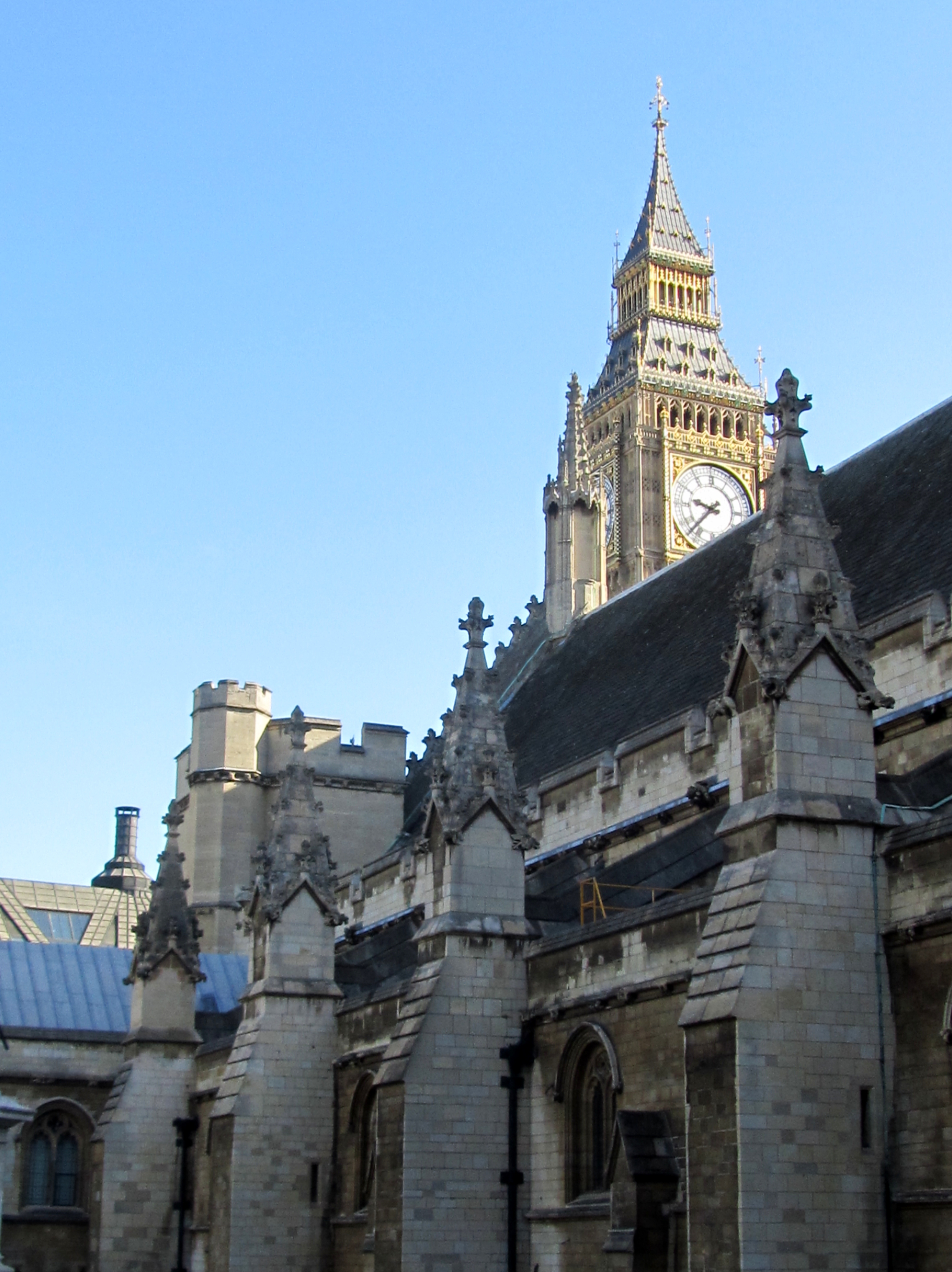
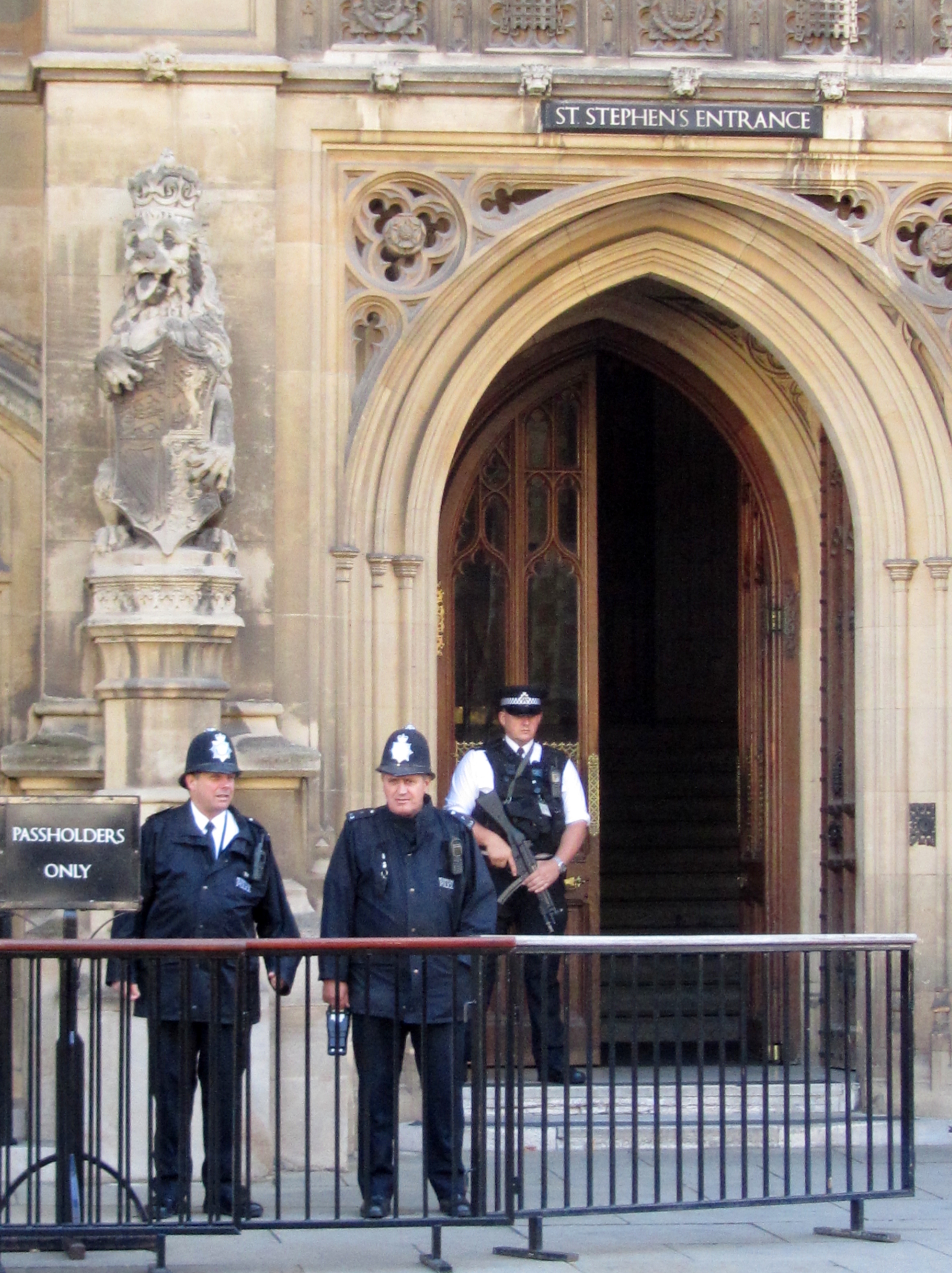
Parliament is located along the banks of the Thames in the heart of London. On the way to our tour, we pass through security that is not quite as stringent as the airport. It makes me a bit sad to think of this venerable and historic democracy having to arm its entrance, but I later learn some historical facts that give me perspective. Today we are with my auntie and uncle, who have traveled from Needingworth in Cambridgeshire to join us for a day of sightseeing. We enter through the Westminster Hall, the oldest surviving section of Parliament, built in 1097-1099 by King William II. I look up to consider the roof, which dates from 1401, and think about roofs in the U.S. that last 20 years. I stand on a plaque noting the date that the Speaker of the House, Sir Thomas More, was condemned to death in 1535. He also was the Lord Chancellor of England and author of the book Utopia. During the tour I learn that various kings would take a disliking to the activity or opinions in the House of Commons and would send soldiers to storm the doors and haul off hapless politicians. I imagine poor Sir More being in this group. In those days one really did need a serious commitment to one’s political platform!
With the exception of Westminster Hall, all of Parliament burned down in the mid 1800s and a new, larger set of structures were built at that time. Practically new by English standards. During World War II a fire forced leaders to choose which buildings to save – they allowed the House of Commons to burn in order to save Westminster Hall. The House of Lords loaned their chamber to their colleagues and there Prime Minister Winston Churchill made many speeches, thumping his fist on the desk for emphasis, leaving dents in the wood. The emphatic damage to the desk remains to this day. I am intrigued by how the British value their past.
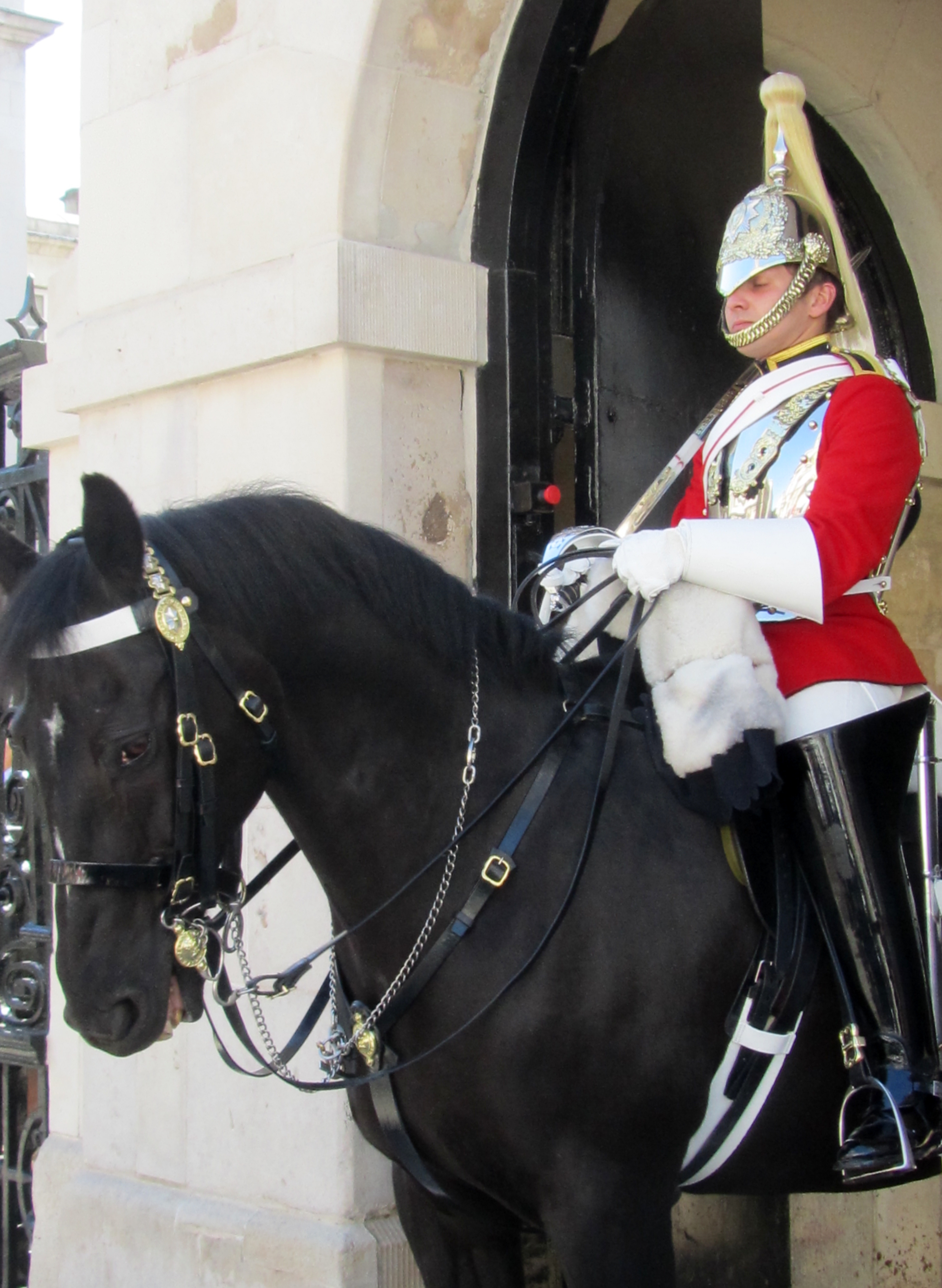
Guarding the House of Commons
As we walk over to the Churchill War Museum, I remember my grandmother’s stories about the air raids in London, running to the tube (subway) with her children – my mother and uncle – holding a small wash tub over their heads in case the bombs hit before they descended to relative safety. The tube was not always safe, sometimes collapsing, sometimes flooding. My family was fortunate to survive, though my grandmother never was able to stop hoarding food and basic supplies (things that were rationed during the war). When she died decades after the war, the family found an enormous supply of toilet paper in the attic.
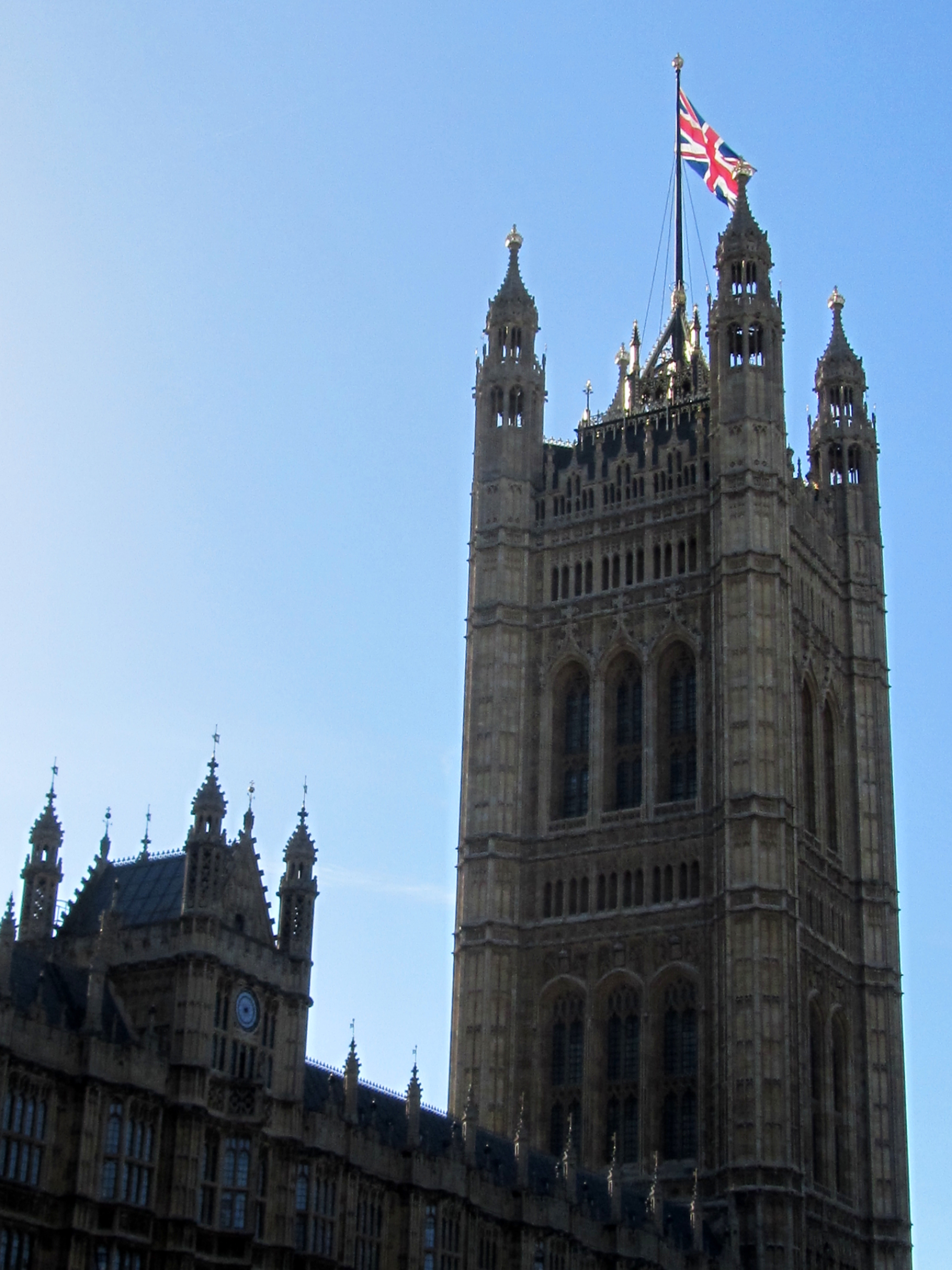
Union Jack flying above Parliament
Churchill was not only an accomplished leader and strategist, but also an author, ultimately winning the Nobel Prize for Literature in 1953. The BBC website has a terrific page dedicated to his accomplishments. I like him most for his eccentric ways (more to come about that in another blog) and his bravery. We are standing in his underground bunker, where he ran the war with a staff of military and civilians. It is just as it was left at the end of WW II – dark, spartan and cramped. The sleeping quarters for all but the PM and high-level staff is awful. The PM had his own room but rarely slept there. He preferred to be above ground and often went on the roof to watch the bombing raids. After one near miss at the front door of the building above the bunker, which was top secret then, he went out to examine the rubble. Churchill also was one of the few in the bunker who knew that the building above them was never completely bomb-proofed.
As I listen to a recording of air raid sirens, still alarming, I think about the determination of this culture, the stoic way they went about surviving month after month of bombing raids. My family, dashing for shelter, with that sound shrieking in their ears. My grandmother had a lot of spunk and I can imagine her yelling to her children to stay close as she railed at the enemy overhead. She talked about the war for years afterward. As a child, I was riveted by her stories and her very colorful descriptions of the enemy.
We pack ourselves onto the tube at the end of the day – another marvel of British ingenuity. The first tunnel opened in 1863, during Charles Dickens’ lifetime, and it was the first in the world. Some parts of it still function today, which is quite stunning to think about as we hurtle down the track.
Tomorrow we head to the British Library – the largest in the world – which holds a vast collection of written records spanning 1,000 years. For now, we sit in the tube train, stuffed with people yet quiet. That British reserve in operation. I feel I understand it, and my own heritage, a bit better.






 Literary wanderings